Black-footed Ferret (Mustela nigripes)

Ecology and Description:
 The
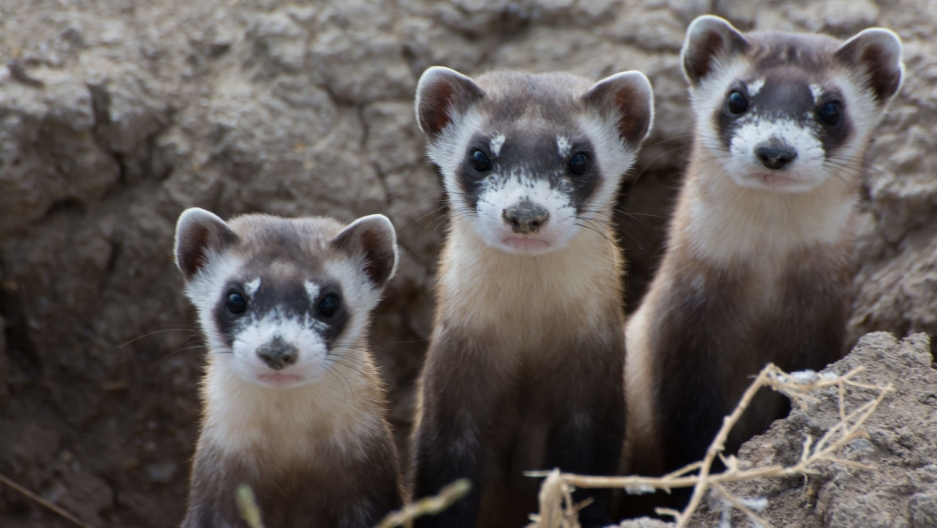
Black-footed Ferret (BFF) is a medium sized member of the weasel family. Weighing in at just 1.4 to 2.5 pounds and measuring 19 to 24 inches
in length It is the only native Ferret species in the Americas. They are slender,
nocturnal carnivores, that have adapted strong jaws and teeth for eating meat. Their
heightened sense of smell allows them to hunt for prey underground.
Black-footed Ferrets are highly specialized predators whose diet consists
almost entirely of prairie dog. Prairie dog’s also supply the BFF with proper
shelter and breeding grounds from their leftover burrows. Their kits are born blind
and defenseless meaning they must stay underground for nearly two months. Mothers
eventually teach them to hunt on their own by taking them on short expeditions
into prairie dog territory.
The
Black-footed Ferret (BFF) is a medium sized member of the weasel family. Weighing in at just 1.4 to 2.5 pounds and measuring 19 to 24 inches
in length It is the only native Ferret species in the Americas. They are slender,
nocturnal carnivores, that have adapted strong jaws and teeth for eating meat. Their
heightened sense of smell allows them to hunt for prey underground.
Black-footed Ferrets are highly specialized predators whose diet consists
almost entirely of prairie dog. Prairie dog’s also supply the BFF with proper
shelter and breeding grounds from their leftover burrows. Their kits are born blind
and defenseless meaning they must stay underground for nearly two months. Mothers
eventually teach them to hunt on their own by taking them on short expeditions
into prairie dog territory.
The
Black-footed Ferret (BFF) is a medium sized member of the weasel family. Weighing in at just 1.4 to 2.5 pounds and measuring 19 to 24 inches
in length It is the only native Ferret species in the Americas. They are slender,
nocturnal carnivores, that have adapted strong jaws and teeth for eating meat. Their
heightened sense of smell allows them to hunt for prey underground.
Black-footed Ferrets are highly specialized predators whose diet consists
almost entirely of prairie dog. Prairie dog’s also supply the BFF with proper
shelter and breeding grounds from their leftover burrows. Their kits are born blind
and defenseless meaning they must stay underground for nearly two months. Mothers
eventually teach them to hunt on their own by taking them on short expeditions
into prairie dog territory.
Geographic
and Population Changes:
/https://public-media.smithsonianmag.com/filer/3d/32/3d320b42-732a-48bd-a754-64174292c4d3/black-footed_ferret_learning_to_hunt.jpg)
The
historical range of the Black-footed Ferret consisted of the Great Plains, mountain
basins, and the grasslands of west-central North America. Their range replicates
the black-tailed prairie dog, Gunnison’s prairie dog, and white-tailed prairie
dog. This close association was the reason for their rapid decline. From the
late 19th century to the mid-1960s prairie dog populations were
dramatically reduced by the transformation of grasslands to croplands,
poisoning, and disease. By the end of the 1960s prairie dog habitat went from
100 million acres to just 1.4 million in the U.S. This problem was so prevalent that the BFF was
thought to be extinct in 1979. It wasn’t until a remaining population of 18
individuals were found in Wyoming in the early 1980s that the BFF was able to
rebound through captive breeding efforts. Today all Black-footed Ferrets are
either in captivity or at managed reintroduction sites. There are approximately
300 Black-footed Ferrets in zoos and breeding facilities and only 500 at 20
reintroduced active sites.
 |
| U.S. Fish and Wildlife Service map of active, immediate, and intermediate reintroduction sites along with prairie dog habitats |
Listing Date
and Type of Listing:

Black-footed
Ferrets have been identified as an endangered species across their range since
March 11, 1967 and were “grandfathered” into the Endangered Species Act in 1973.
Today the U.S. Fish and Wildlife Service (USFWS) assigned the BFF a recovery priority
level of 2C which means the ferret faces a high degree of threat with high potential
for recovery. In 2014 the USFWS conducted a five-year review of the species which
concluded that the BFF continues to justify federal endangered status.
Cause of
Listing and Main Threats to Continued Existence:
The main threat
for the existence of the Black-footed Ferret is deficient management and
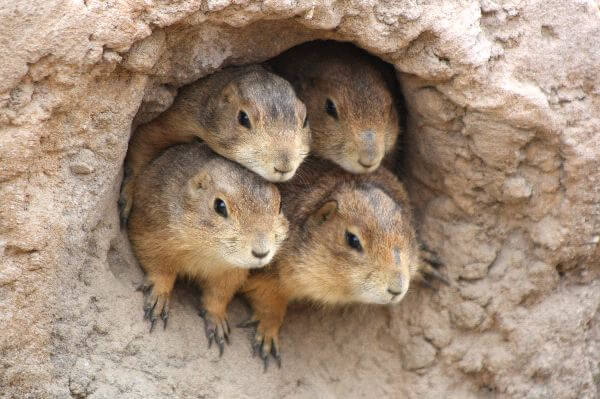
conservation of prairie dogs. Making up
over 90% of their diet, prairie dogs are the only animal helping sustain the
species. Grasslands in the Great Plains turned into agricultural land substantially
reducing prairie dog populations between the late 1800’s until the early 1960’s.
Toxins also played a huge role in the specie’s decline. It wasn’t until Executive
Order 11613 which prohibited the use of specific toxicants that could cause
secondary poisoning on Federal Land. Adding to the problem was canine distemper
and sylvatic plague. Canine distemper is as systematic disease with a fatality
rate in unvaccinated ferrets of nearly 100%. Sylvatic plague infections are spread
through fleas that acquire the bacterium from an infected animal. Both the
prairie dog and BFF are highly susceptible to these diseases. Vaccines have
dramatically helped ferrets combat these illnesses but do not pose a long-term
solution for them in the wild.
Recovery
Plan:


What Can You
Do:

At the individual
level humans can play a major role to help save the Black-footed Ferret. If you
reside in the Great Plains let friends and family know why we should respect and
preserve BFF and prairie dog habitat. Defenders of Wildlife is a non-profit
organization whose mission is to protect all native plants and animals from
extinction like the BFF. You can donate by following the link to their website posted below
and buying a symbolic stuffed animal to help support their cause. Talking to politicians, letting them
be aware of the situation and why they should donate to such organizations to
protect native animals is essential. The health of the BFF represents the
health of the plains. How much of the environment we are willing to sacrifice
for human development? This is a question everyone should be asking their government officials and what their plans are to help protect our natural
ecosystems.
Defenders of Wildlife link:
https://secure.defenders.org/site/SPageServer?pagename=wagc_homepage#/gifts
References:
Belant, J., Biggins, D., Garelle, D.,
Griebel, R.G. & Hughes, J.P. 2015. Mustela nigripes. The IUCN
Red List of Threatened Species 2015: e.T14020A45200314.
“Canine Distemper in Ferrets.” Mustela Nigripes (Black-Footed
Ferret),
www.iucnredlist.org/details/14020/0.
Lockhart, Mike. “Black-Footed Ferret.” Black-Footed Ferret,
https://www.fws.gov/mountain-prairie/factsheets/Black-Footed-Ferret.pdf
Parker, Laura. “Saving Endangered Ferrets… With Peanut Butter.”
National Geographic, 19 July 2016, https://news.nationalgeographic.com/2016/07/prairie-dogs-ferrets-animals-science-vaccines/.
U.S. Fish and Wildlife Service. 2013. Recovery plan for the
black-footed ferret (Mustela nigripes). U.S. Fish and Wildlife Service, Denver,
Colorado. 157 pp.
Credit for Images in Chronological Order:
1.
https://www.daveshowalter.com/photo/black-footed-ferret/
2.
https://www.pri.org/stories/2017-09-23/black-footed-ferret-making-comeback-great-plains
3. https://www.smithsonianmag.com/smart-news/how-feeding-prairie-dogs-peanut-butter-could-help-stop-plague-and-save-ferrets-180955937/
4. https://ecos.fws.gov/docs/recovery_plan/20131108%20BFF%202nd%20Rev.%20Final%20Recovery%20Plan.pdf
5. https://ecos.fws.gov/docs/recovery_plan/20131108%20BFF%202nd%20Rev.%20Final%20Recovery%20Plan.pdf
6. https://prime.peta.org/2017/05/prairie-dog-say-might-think
7. https://zooamerica.wordpress.com/2011/09/23/30th-anniversary-of-the-rediscovery-of-black-footed-ferrets/
8. https://ecos.fws.gov/docs/recovery_plan/20131108%20BFF%202nd%20Rev.%20Final%20Recovery%20Plan.pdf

The fact that their kits are born blind and unable to defend themselves stresses the importance of conserving their young. - James Yates
ReplyDeleteIt was interesting to learn that the black footed ferret is the only ferret native to the Americas — I had no idea about this. It was also very interesting to learn that the main reason for the endangerment of the black footed ferret is directly caused by the population decline of prairie dogs. I hadn’t really considered how much the loss of one species could directly affect another. It was reassuring to read that the species is expected to recover if its habitat is well-maintained, it would be a shame to have yet another species go extinct in our lifetime.
ReplyDelete-Kellie Williams
I have multiple aunts/uncles that live in or around the midwest and I never knew how crucial prairie dogs were to the environment until now. It's so easy to overlook something when it's always in front of you so it just goes to show how important public awareness is. Although, it sounds like this species can make a full recovery through successful captive breeding and more awareness! -Hope Young
ReplyDeleteTheir loss of habitat was shocking to me. Going from 100 million acres to just 1.4 million acres is absolutely insane. It's so easy to put these statistics to the side and not acknowledge the importance of the species. I hope people who reside in the Great Plains help out and make a difference in the lives of Black-footed ferrets. -Morgan White
ReplyDeleteAfter learning about how crucial these prairie dogs are, I now want to take a course of action. I am going to figure out how I can support the defenders of wildlife. -Max Tannenwald
ReplyDeleteHey Jason! It was fun reading about the Black-footed Ferret (Mustela nigripes). Your blog was easy to understand and the information was clearly laid out. I thought the way in which you displayed your recovery information was important and interesting. It was easy to see what was causing the issues and what could be done to stop it. -Nick Vollucci
ReplyDeleteJason, I was surprised to learn that there was such a high mortality rate for unvaccinated ferrets. I would have never thought that a common house pet such as a ferret could at such risk. Nice job! -Rick Taggesell
ReplyDeleteTwo months is a long time to stay blind and helpless in a burrow. That must make taking care of the young hard for conservationists! -Austin Whaley
ReplyDeleteI loved that you chose this animal, I was interested in class and I was able to learn so much in this blog! Your conservation plan was very well laid out regarding finding suitable habitat and the captive breeding. - Gabe Worthington
ReplyDelete