The Southern Sea Otter (Enhydra lutis nereis)
 |
| [Fig. 1] |
Description & Ecology of Organism - Sea otters are unanimously loved
for their adorable, and seemingly cuddly, appearance. Their rounded faces, big
eyes, and little black noses create the image of an animal that could do no
harm to another organism. However, the sea otter species (Enhydra lutris) has readily adapted into an avid marine hunter. At
an average length of four feet, they are the largest member of the Mustelidae
(weasel) family, yet the smallest marine mammal in North America.
Sea otters do not have blubber or a
significant amount of fat on their bodies so they must rely on extremely dense
fur to keep them warm and dry. Otters typically reside in hard- and
soft-sediment habitats, like protected bays and exposed outer coastline. They
use their sleek bodies and webbed feet to dive down to depths up to 200 feet in
order to capture their prey. Sea otters are also one of the only mammals known
to use tools for hunting and eating their food. Sea urchins, crabs, clams, and
more marine invertebrates don’t stand a chance against the rocks that sea
otters have learned to use [Fig. 3].
 |
| [Fig. 2] |
Geographic & Population Changes -
The entire sea otter species used
to reside across the globe, ranging from the Eastern islands of Japan all the
way down to Baja, California. A plethora of threats including overexploitation,
disease, and habitat degradation, broke up the species into two main
subspecies, northern and southern sea otters (Enhydra lutis nereis). The southern sea otter has a current population
total of about 2,150 animals that ranges from Half Moon Bay to Point
Conception, California. Based on scientific analyses of sea otter carrying
capacity, the minimum number of individuals in a population (at optimum levels)
should be around 8,400. The species had an estimated population of 16,000
individuals up until the fur trade, which nearly decimated sea otters entirely.
Listing Date & Type of Listing - The Southern sea otter was listed as “threatened” in 1977 under the Endangered Species Act. They were placed under recovery priority 9C, meaning that they are a subspecies facing a steady level of threat but have a high potential for recovery. They were also recognized as “depleted” under the Marine Mammal Protection Act.
Cause of Listing & Main Threats to Continued Existence - Southern sea otters were listed as “threatened” because they have such a small population size and very limited distribution. Since the early 1970s, their population has hovered around 1,250-2,300 individuals and we have yet to see any increasing population trends.
 |
| [Fig. 3] |
Listing Date & Type of Listing - The Southern sea otter was listed as “threatened” in 1977 under the Endangered Species Act. They were placed under recovery priority 9C, meaning that they are a subspecies facing a steady level of threat but have a high potential for recovery. They were also recognized as “depleted” under the Marine Mammal Protection Act.
Cause of Listing & Main Threats to Continued Existence - Southern sea otters were listed as “threatened” because they have such a small population size and very limited distribution. Since the early 1970s, their population has hovered around 1,250-2,300 individuals and we have yet to see any increasing population trends.
 |
| [Fig. 4] |
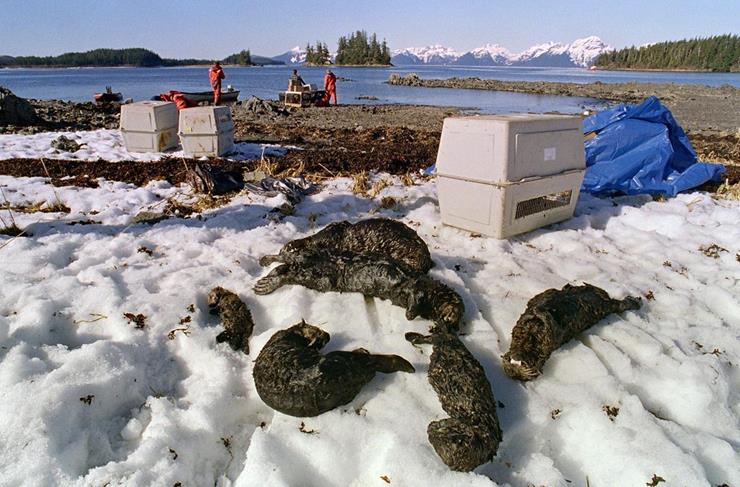
They were also listed because of
the extremely high-risk threat of oil spills. The U.S Fish and Wildlife Service
believe that oil spills will continue being the determining factor on whether
or not sea otters will survive in California. Oil spills are detrimental to sea
otter populations because the oil negatively interacts with their fur’s
insulating properties, leading to hypothermia and death. There is only a 50%
survival rate for animals that come into contact with oil so another accident
like Exxon Valdez could wipe out the entire population.
 |
| [Fig. 5] |
Description of recovery plan - A southern sea otter recovery plan was created in 1982. The
goal is to, “establish the long-term viability of the southern sea otter
population sufficiently to allow delisting the species”. The primary objective
of the recovery plan is to create optimal environmental conditions that would
allow the species to increase in numbers and range distribution. In order to be
delisted, the southern sea otters would have to reach an average of 3,090
individuals or more for three years in a row. This can be done through more
regulation of coastal vessel traffic (to decrease the risk of accidents) and
continued efforts against oil spills (to reduce likeliness and impacts of more
occurring).
What Can You Do? - The general public can make a difference in the survival of
the southern sea otter! The easiest and most important way is to cut down on consumption
of oil and oil-based products. Plastic is an oil-based product so use more
paper or reusable bags while at the store and around town. Dispose of all
cooking oils and car oils properly otherwise they go straight into the ocean. Protesting
oil drills is also another great way to create public awareness about wildlife
being harmed as a result of human consumption. Check out these sites if you
want to become even more aware of what is happening to wildlife around the
world!
U.S. Fish & Wildlife Service - https://www.fws.gov/ventura/endangered/species/info/sso.html
NOAA - http://www.noaa.gov/
References -
[Fig. 1] : http://2.bp.blogspot.com/-
[Fig. 3] : https://sanctuarysimon.org/regional_images/site_build/special_spp_otter_fig1.gif